
Ferrari 512 TR Cambelt Service: When Experience Meets Engineering Excellence
Elite Motorworks · James Blunden · Bob Houghton Ltd
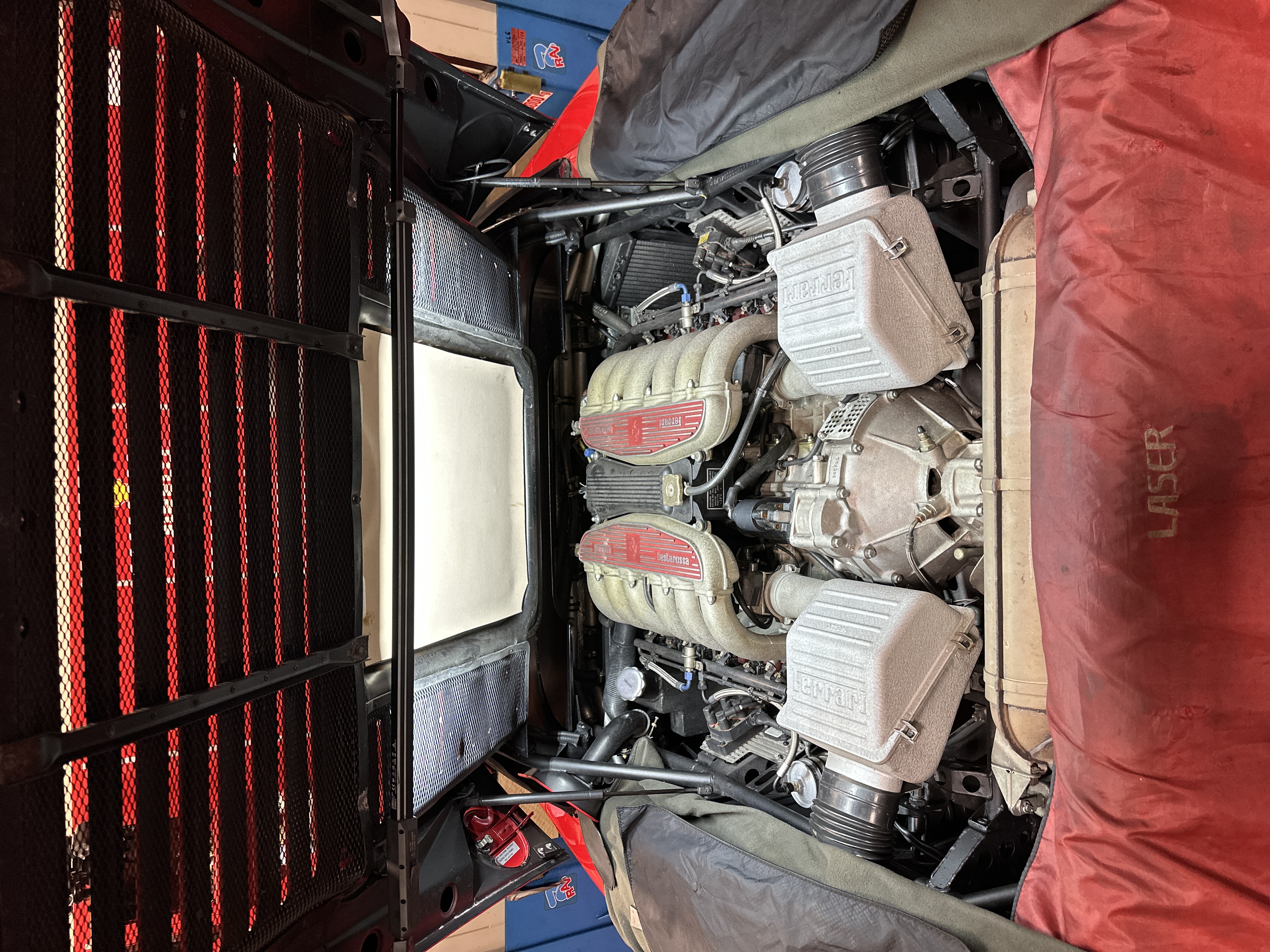
The Ferrari 512 TR flat-12 out on the stand — Bob Houghton Ltd workshop.
Some jobs remind you exactly why you got into this industry. Servicing a Ferrari 512 TR is one of them.
A Rare Machine Deserving Rare Expertise
The Ferrari 512 TR is not your everyday vehicle. Built between 1991 and 1994, it — like its predecessor, the Ferrari Testarossa — was an underappreciated classic, but in recent years it has gained massive popularity among collectors and enthusiasts. A naturally aspirated flat-12 engine producing over 420bhp, 0–60mph in 4.8 seconds, and wrapped in an iconic Pininfarina body. With fewer than 2,500 ever made, every one that comes through the workshop carries serious responsibility with it.
This particular 512 TR was worked on during James's time at Bob Houghton Ltd — one of the UK's most respected classic and specialist vehicle specialists. The brief: a full cambelt service. Simple enough on paper. In reality, a job that demands precision, patience, and a deep respect for the machine.
Why a Cambelt Service on a 512 TR Is Anything But Routine
On most modern vehicles, a cambelt replacement is a straightforward job. On a Ferrari 512 TR, it's a different story entirely.
The flat-12 engine sits mid-mounted with the gearbox running directly underneath — meaning to access the cambelt properly, the engine and gearbox have to come out. That alone transforms what might be a half-day job on a family hatchback into a multi-day, highly involved process requiring specialist knowledge, the right equipment, and — critically — the right hands.
Here's what the job involved:
Full Vehicle Inspection & Health Check
Before carrying out major surgery like this, you need to know exactly what you're working with — going through the vehicle top to bottom, front to back, before a single fastener is touched.
The Road Test Question
Many Ferraris carry significantly low mileage — which helps retain or even improve their market value. Some have been parked for extended periods with an unknown timing belt history. Where possible, a road test prior to commencing work is preferred: it allows us to assess vehicle performance and handling and identify any unforeseen issues before the engine comes out — allowing time to order or refurbish parts while the cambelt replacement is already underway.
If the safety of the engine is in question, or the client requests a reduced or no road test, we make them aware that any faults identified post-repair during the final quality checks may require the work to be carried out again — increasing labour costs and potentially delaying the job if parts need ordering or refurbishment.
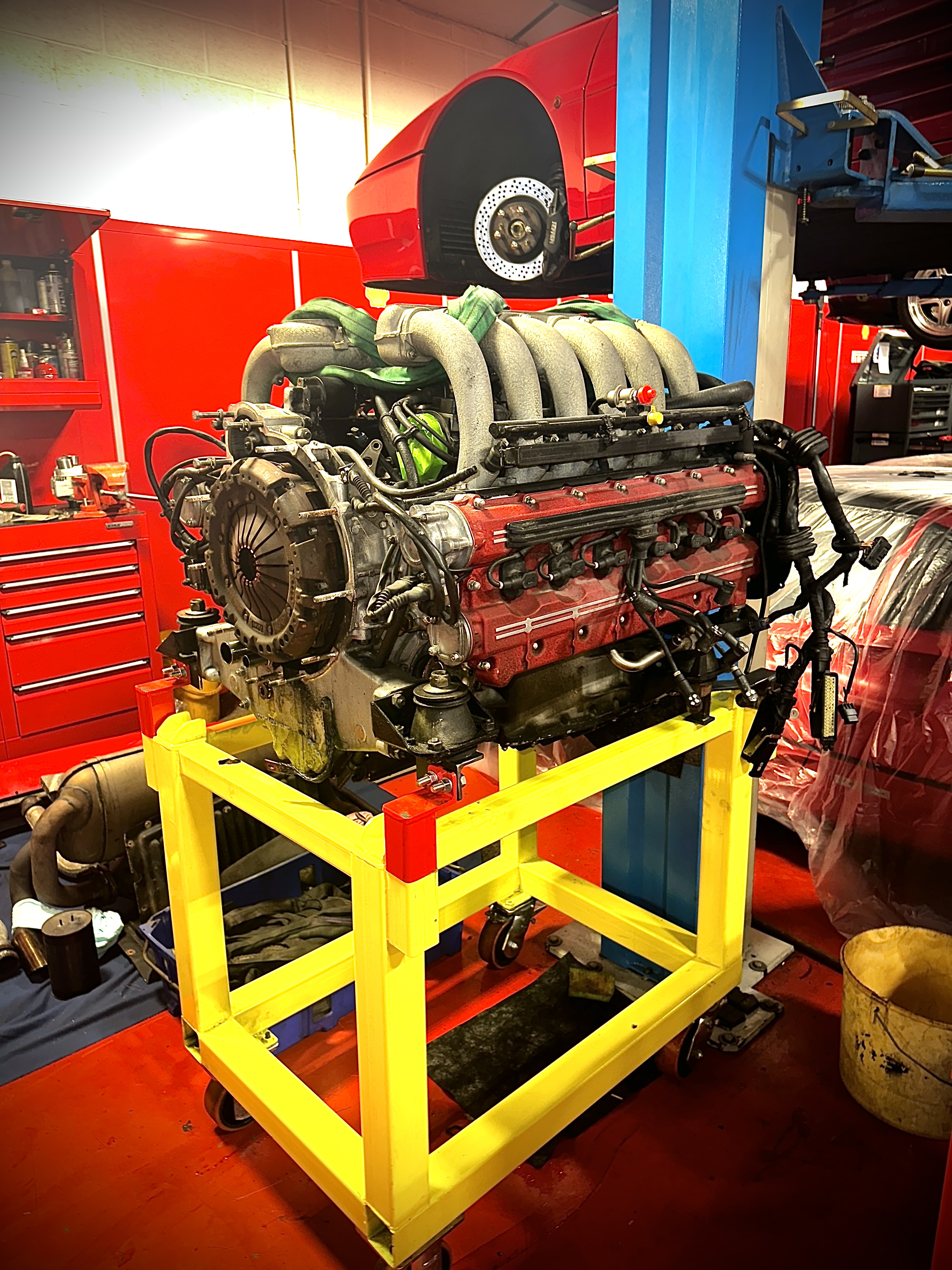
Engine bay with the flat-12 removed — the scale of the job becomes clear.
Full Engine Removal
Following complete draining of the engine fluids and air conditioning system, and careful disassembly and documentation of the surrounding components, the flat-12 was carefully extracted from the chassis — requiring multiple adjustments of the engine's angle and position to clear the bulkhead and rear frame without damaging any surrounding components.
Systematic Disassembly
Working methodically through layers of ancillaries to reach the belt drive system — each component documented, labelled, and set aside in the correct order for reassembly.
Cambelt & Tensioner Replacement
New components fitted to manufacturer specification. On a flat-12 of this age, there is no room for approximation — timing must be set precisely and verified before any reassembly proceeds.
Full Reassembly & Refit
Returning everything to exactly how it should be, with no shortcuts. Every fastener torqued correctly, every component refitted in sequence, every fluid refilled to specification.
The Challenge of Age: Handling a 30-Year-Old Supercar
This 512 TR is over 30 years old — and that age brings with it a unique set of challenges that go well beyond the mechanical complexity of the job itself.
Rubber seals, hoses, gaskets, and fasteners that have spent three decades in a high-heat environment become brittle and fragile. Components that would unscrew easily on a newer vehicle can seize, crack, or crumble under the wrong approach. Wiring looms, clips, and brackets need to be treated with care — not forced.
This is where experience becomes everything. Knowing how to handle aged components — when to apply heat, when to use penetrating fluid, when to slow down — is the difference between a clean, successful job and an expensive mistake. Every fastener, every seal, and every aged component was approached with the same careful, methodical process. The result: a clean, successful cambelt service with the engine returned to the car in perfect condition.
The Expertise Behind the Work
James holds IMI Level 2 and Level 3 qualifications in motorsport vehicle maintenance and repair and brings nearly 20 years of hands-on experience across everyday vehicles, high-performance cars, and classic restorations.
Work of this calibre — on vehicles of this rarity and value — requires more than technical knowledge. It requires the kind of instinct and confidence that only comes from years of working on complex, demanding machinery. That's what Elite Motorworks brings to every job, whether it's a routine service or a full engine-out restoration.
Classic Car Expertise at Our Ledbury Workshop
Our dedicated workshop in Ledbury, Gloucestershire is fully equipped for complex repairs, restorations, and engine work that simply can't be done at the roadside. From classic Land Rovers and Porsches to rare Ferraris, we have the tools, the space, and the expertise to handle vehicles that demand the very best.
Trust your classic to someone who understands it
Whether it's a scheduled service, a complex repair, or a full restoration project — get in touch and let's talk about your vehicle.
Get in touch